EXPLORE THE WORLD OF TINEE

Showing posts with label travel. Show all posts

Tuesday, March 25, 2014

Egypt unveils two massive restored pharaoh statues

Egypt unveils two massive restored pharaoh statues


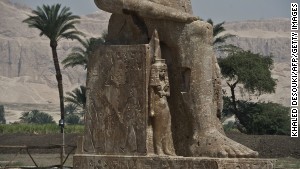
Archeologists in the historic city of Luxor, Egypt have unveiled two massive ancient statues of Pharaoh Amenhotep III to the public.

The newly restored quartzite statues, one of which is more than 11 meters high and weighs 250 tonnes, can be found at the funerary temple of Amenhotep III.

They join a pair of already famous giants at the temple known as the Colossi of Memnon -- two 16-meter-high images of King Amenhotep III
seated on his throne, also made of quartzite.

The unveiling was presided over by German archaeologist Hourig Sourouzian, who heads the temple of Amenhotep III conservation project.

The two new statues, discovered during excavations at the site, were originally in pieces before being restored and raised to their current standing position at the temple.

According to the World Monument Fund (WMF), the temple of Amenhotep III was erected between 1390 and 1353 B.C. for the pharaoh. It was 100 meters wide and 600 meters long, but only the lower sections of the structure remain.

Pharaoh Amenhotep III and his wife Tiye.

The Colossi of Memnon, which mark the entrance of the temple of Amenhotep III, are the most visible remains of what was once the most richly ornamented of all Thebanmonuments, says the WMF.

"The temple structure was originally destroyed by earthquakes, and, since it was never fully excavated, the site was overgrown with vegetation and threatened by seasonal floods and agricultural development," says the organization.

"These problems were compounded by an increase in surface salts from rising groundwater, a by-product of the construction of the Aswan High Dam in the 1960s."

Luxor, 635 kilometers from Cairo, is divided by the Nile into two areas commonly referred to as the East and West Bank -- the latter home to some of Egypt's most prized ancient temples and monuments.

The unveiling comes at a time when Egypt's tourism sector is fighting to pull itself out of a slump due to political instability that's lingered since the ousting of Hosni Mubarak in 2011.

According to the Daily News Egypt, Tourism Minister Hisham Zaazou said on Saturday that the tourism sector is completely collapsed, adding that great changes are needed to improve conditions.

TINEE discovers her own massive statue
Hawk Bridge Island


While traveling through Cloudstown one day, Tinee came across a floating island.


Thursday, March 6, 2014

CRUFTS 2014: THE WORLD'S BIGGEST DOG SHOW - TINEE WAS THERE!

Crufts 2014: the world's biggest dog show in pictures

The world's largest dog show is set to return with the four-day event starting on March 6.
Taking place in Birmingham's National Exhibition Centre, the self-dubbed "biggest and best celebration of dogs," per Crufts website, will comprise of four-days worth of varied contests.
Showcasing the dogs' skills, using tests in agility, obedience and rally, as well as showing and ringcraft, dogs and their owners will take part in the hotly-contested tournament, as well as battling for the crown of Best In Show.
Broken up across breed categories, one dog from each group—Working, Utility, Hound, Pastoral, Toy, Terrier and Gundog—will reach the final round to compete for the Best In Show title on the final day.

The event will conclude on March 9, and with just one bull terrier winning Crufts to date, there's room for Walker and her dogs to pick up an historic victory this time around.
Abraxas Audacity's win in 1972, per AllPosters, was the last time that a bull terrier won the tournament, with the Staffordshire relative yet to pick up a victory since the competition's formation in 1891.
But a win for the Staffies this time around would not only create history, but open up the competition to other breeds and give more varied competition to the dog lovers' event.


Monday, March 3, 2014

THEATER REVIEW - Broad Stage = MYTHICAL PLAYGROUND: BRAZIL - TINEE WAS THERE

MYTHICAL PLAYGROUND: BRAZIL
THE REVIEWS ARE IN!!!


Friday night around the dinner table, the girls (Esmé &Üla’ - 7 & 10 year old sisters ) shared what they witnessed and experienced at Mythical Playground: Brazil.
Esmé really liked the girl on the piano (Actress Julia Keefe), but she preferred (Actress Cassandra Nwokah) the house slave.
She was fixated on how Cassandra was bent and learned different ways to convey age and culture with clothes and accents.
Cassandra gave space around everything she said, to convey import.
Üla’s was most impressed with the student (Actor Colin Simon) of the Shaman (Actor Vikas Adam) (Esmé called the Shaman the Chief).  She acted out his bird imitation and the Shaman’s lines word for word.
Üla really liked when he (Colin) rolled out his long name and she (Julia) asked what it meant and he said, “boy.” She so got the joke.
Esmé jumped on the fact that the student’s (Colin) voice went up when he asked the girl (Julia) “can you play more for ME?”
They both loved the (Interaction & Sing-A-Long) call to response portions.  And it didn't seem like too much for them.  They absorbed it all.
They both alluded to the Termite joke in different ways this weekend.  Parodying it and when a comparison was made with a group of people on a show, Üla said, no mom, the termites are white those people aren't.  And we all loved the interaction on the fly when the kid in the audience said, “She doesn't look like a termite.” Colin's ad lib and said "No, she doesn't, she looks like a Princess."  So well played.
And I had fears that more and more children would rise from the audience and overwhelm the performers – but it was perfect. 

We enjoyed it and are still unraveling the complexity that Mythical Playground: Brazil gave a basis for.  Thank you

ANCIENT BEASTS ROAM SPAIN'S WILDERNESS - TINEE WAS THERE!

Ancient beasts roam Spain's wilderness

AFP 
Campanarios De Azaba (Spain) (AFP) - In an oak wood spanning the border of Spain and Portugal, an ancient sight unfolds: wild horses, not saddled or shoed, but roaming free as they did centuries ago.
Farming has declined in Spain, leaving the countryside deserted, conservationists say. Now the wild things are coming back: wolves, vultures and rare herbivores.
Dozens of Spanish "Retuerta" horses have been released over the past two years here into the 500-hectare (1,235-acre) Campanarios de Azaba Reserve.
"It's a wonderful horse that has been around since time immemorial," despite coming close to extinction, said Carlos Sanchez, director of the conservation group running the site.
"We are recovering the most primitive breeds to try to help manage an ecosystem which has been abandoned due to the disappearance of humans."
Nuzzling its mother's velvety brown hide, a foal suckles then disappears among the trees with the grazing herd.
"We released these animals to live by themselves, to take care of themselves in their environment," said conservationist Diego Benito, 35.
"We don't feed them. We just watch them and monitor how they are doing in their groups, which are the dominant horses and which of the mares are pregnant."
Overall in existence there are only about 150 Retuertas -- identified by genetic studies as one of the oldest horse breeds in Europe.
They were brought from the Donana National Park in southern Spain -- previously the only place where they existed -- to create a second breeding site in Campanarios, where they now number about 50.
Sharing the reserve with rare vultures and free-roaming cows, the Retuerta horses are among the animal pioneers of what conservationists call "rewilding".
The Campanarios reserve is part-funded by Rewilding Europe, an initiative for development through "wild nature" in various countries.
"For the first time in history, Europe is facing a situation where there is no grazing anymore," said Frans Schepers, managing director of the Netherlands-based organisation.
"There has been a lot of land abandonment in Spain over the past few decades," he said.
- Wildlife comeback -
Therefore, in recent years "Spain has shown a very interesting wildlife comeback," with wolves, vultures and even the endangered Iberian lynx recovering in numbers, he added.
Rewilding aims to turn this into an economic opportunity, to draw visitors and revive abandoned rural areas in the long-term.
The Campanarios reserve, currently inhabited just by the animals and a handful of staff, aims to draw groups of wildlife spotters and boost the local economy.
Jon Teixeira, 27, works in the reserve planting trees, releasing rabbits and leaving dead chickens for vultures to feed on.
"I am glad there is a reserve here -- that way we'll have jobs in the area, where there's a lot of unemployment," he said.
"And it's a good job there's a place where you can't hunt, otherwise all the animals would be wiped out."
Elsewhere, conservationists this month released a herd of wild oxen to graze in a reserve near the northern Spanish city of Burgos.
- Stone age safari -
In the coming months they plan to add endangered European bison and other breeds of wild horse to the reserve.
The oxen were set free near the Atapuerca prehistoric site, where archeologists have dug up human remains more than a million years old.
Conservationists want to take people visiting the dig on a stone age safari to see the living descendants of the beasts that roamed the area aeons ago.
"In the archaeological site lie the bones of the ancestors of todays' species. These are their evolutionary descendants," said Fernando Moran, a bison specialist at the park.
The Atapuerca site is not part of the Rewilding Europe initiative, but it shares the aim of drawing money and jobs to the abandoned rural areas while also preserving endangered species.
"It is about nature conservation, but also tourism, development and land management," Moran added.
"Spain is in general a fair bit more wild than the rest of Europe. Lots of hectares are being left empty, which for wild animals are obviously perfect."

Sunday, March 2, 2014

RED CARPET HISTORY - TINEE WAS THERE!

TINEE checking out RIVER OSCAR

Last night, Academy Award Officials were showing signs concern as to whether "WEATHER" or not the rain would be kind to the BIG event tomorrow. 

Red Carpet Luxury Kayak Rentals were being considered.

O'NEIL Wet Tux's were also ready and standing by.


1922 Robin Hood Premiere

For decades, stars great, small and dubious have swanned down the Oscars’ regal rug. Turns out the backstory is as rich and multifarious as a David O. Selznick epic.

1922
Hollywood’s first red carpet event usually is ascribed to the opening of Sid Grauman’s Egyptian Theatre and the premiere of Robin Hood, starring Douglas Fairbanks. The irrepressible Grauman, a founding Academy of Motion Picture Arts and Sciences member, later would take credit for the red carpet becoming a staple at Hollywood events.
1961
The first Oscars red carpet is rolled out at the 33rd Academy Awards on April 17, 1961, at the Santa Monica Civic Auditorium.
1966
The Oscars are broadcast in color for the first time, giving millions of viewers a glimpse of the red carpet in living color on fruitwood-trimmed console Zeniths.
1992
The American Turf and Carpet company takes over making the Oscars’ red carpet. The continuous filament nylon creation is manufactured and dyed in Dalton, Ga., and replaced every two years. The carpet is not wholly red. It’s dyed with a proprietary blend of colors used exclusively for the carpet to make it read red on television (“Nancy Reagan Red,” Rivers has called it) and sealed to prevent the color from degrading under assault from innumerable ManoloBlahniks.
2001
The Oscars move to the Kodak (now Dolby) Theatre. The red carpet follows.
2003
U.S. forces invade Iraq three days before the Oscars. In deference, the preshow hoopla is scaled back dramatically, including the red carpet itself, which shrinks to a vestigial doormat in front of the theater entrance.
2013
A metastasizing number of awards events and premieres inspires organizers to roll out carpets in yellow (like at 2013’s Nickelodeon Kids’ Choice Awards), blue, pink and even white. The Grammys, Emmys and Oscars remain steadfastly red.
2014
Today’s Oscar red carpet has grown to 16,500 square feet and takes two days to install. Scraps are jealously guarded to keep them out of the mitts of eBay trolls.


MYTHICAL PLAYGROUND: BRAZIL - TINEE WAS THERE!!


MYTHICAL PLAYGROUND - BRAZIL
LIVE AT THE BROAD STAGE
TINEE WAS THERE!
Santa Monica, CA - The BROAD STAGE in Santa Monica and the IPANEMA THEATER TROUPE with Brazilian director Gulu Monteiro and Costume Designer Swinda Reichelt, this newest theatrical creation guides us through the dynamic music, heritage and culture of Brazil. Mingling modern traditions with the folklore of old, Monteiro weaves a new classic tale for children and the young at heart.  
Ipanema Theater Troupe
The unique spirit of 18th century Brazil as we explore their heritage through music and culture and follow the story of a Native boy who falls in love with a European girl who encounters the wisdom of the girl’s African caretaker.

Starring:  
VIKAS ADAMCLARA BELLAR
STEVEN HOUSKA
JULIA KEEFE
CASSANDRA NWOKAH
COLIN SIMON
GULU MONTEIRO
DREW LOVE
ANAS SAHIBI
EROCK M dos SANTOS
AMEN SANTO


Tuesday, February 25, 2014

EXCEEDING HUMAN LIMITS, they completed Captain Scott’s ill-fated South Pole trek - TINEE WAS THERE!

How two men succeeded where

Captain Scott failed

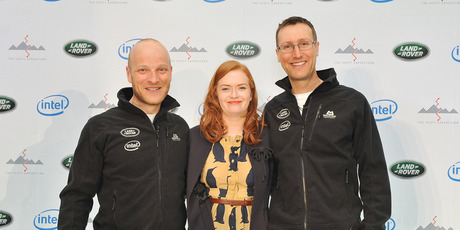
Polar explorer Ben Saunders and Tinee pictured in Antarctica. 
No one has ever completed Captain Scott’s ill-fated South Pole trek – until now. But, Ben Saunders tells The Independent, the biggest challenge was in convincing people how extraordinary the feat was.

As Ben Saunders sat in his tent updating his blog, the Antarctic wind in a foul mood outside, he could no longer feel his fingertips. Saunders and his co-explorer Tarka L'Herpiniere were 99 days into what would become a 105-day trek recreating - but, crucially, surpassing - Captain Scott's ill-fated 1912 expedition across the South Pole.
In one sense, they should have been in good spirits: Scott and his team had perished 11 miles short of their finish point, while Saunders and L'Herpiniere were alive. But they were cold, emaciated, weak and tired.
"We've had some wonderful, well-meaning messages imploring us to enjoy and treasure and cherish these last few days on the ice," Saunders, 36, wrote on 31 January, "but the truth is that the days are hellish now, and it's all we can do to keep moving, battling the ever stronger desire to stop and rest (or give in and quit entirely)."
The reader felt for him, of course, but not that much. No one had actually forced them out there, had they? Besides, we live in a world now where seemingly everyone - or at the very least actors, comedians, Typhoo Tea spokesmen, and the occasional fourth in line to the throne - is out there indulging in extreme adventurism while audibly complaining about how much it all hurts.
"We have extra food tomorrow, so things may improve," he continued, "but the enjoyment of these next few days will, I fear, only come in hindsight."

Whatever did they expect?
That was three weeks ago, and the journey was completed, successfully, six days later, after which he and L'Herpiniere repaired to Chile, to warm up, eat, and recover. Saunders is back in London now, sitting in front of me in his office space in Clapham, south-west London, and hindsight is very much in full effect. Though Clapham high street could be, for all sorts of reasons, far more dangerous than the Antarctic ever could be, he considers himself back on safe ground, familiar territory. He's just not sure he wants too much exposure to it; all those Sainsbury's, those great many Starbucks. "Being back here is very, very odd," he says, running a hand over his cropped hair. "I'm finding readjusting to real life quite difficult right now."
Looking at the man, you wouldn't think he'd just walked himself into the record books. All the weight he lost on the ice, 20kg, he's put back on, and beneath the white T-shirt that bears his name alongside those of his sponsors, Intel and Land Rover, is a lot of carefully cultivated muscle. He looks as if he spent the past three months in the gym rather than defying the bitter expanse at the bottom of the world.
Nevertheless, he and L'Herpiniere's achievements are mighty. The pair completed the longest man-haul polar journey in history, trekking 1,800 miles over pure white nothing while pulling supplies of up to 200kg for almost four months. "Or, to put it in another context, we completed 69 marathons back to back in the harshest place on earth - the coldest, the windiest, the driest, and the continent with the highest altitude. From a purely physical point of view," he says, "it really was a massive challenge."
One could argue that this doesn't need quite such strenuous underlining, but then again perhaps it does. If we really do live in a world where we're all wannabe Ben Fogles and Bear Gryllses, then it is increasingly easy to overlook what feels like just another polar expedition. "Yes, but no one has ever attempted what Scott did, not in 100 years. There is this misconception that everything in the world has been explored, but that's just not true."
From left, Ben Saunders, Lucy Scott, great granddaughter
of Captain Scott, and Tarka L'Herpiniere.
Consequently, one of the biggest challenges that the pair faced was convincing people of the enormity of their challenge. "Most contemporary expeditions are merely contrived publicity stunts. You know, the first left-handed Irishman on a stick, or the first person to ride there on a bike, or simply the latest Blue Peter presenter." But this, he insists, was different. "Our motivation was about exploring human limits: just how much are we capable of?"
Before he left, a friend told him that his grandmother was also headed to the Antarctic, on a cruise. "Do you think you might see her while you're down there?" he was asked. Saunders sighs. "I don't want to sit here and bad-mouth people, and say that, well, you know those wounded soldiers? They were only planning to do 200 miles..." Lest he give the impression of criticising the Walking With The Wounded charity, which last year trekked to his Pole of choice in the company of Prince Harry, he quickly adds that he knows a lot of them personally. "And I think what they achieved is incredible," he says. "I know how hard it is to do anything in those conditions as an able-bodied person, so I can't imagine what it must be like doing it while having to deal with a prosthetic limb."
"Being back here is very, very odd" Any Antarctic trek is an achievement, then. It's just that no one has ever walked that far, down there, in those conditions. They have now.
An affable man of genial disposition, Saunders likes to point out, a touch self-consciously perhaps, that he was not a born explorer; the tacit suggestion, presumably, is that some are. "It's not like I'm Sir Benjamin Saunders of so-and-so, and that I come from a long line of noted explorers. No, I'm entirely normal, ordinary. I went to state school, and didn't even make it as far as university." He nevertheless does sound rather well bred. "The posh accent?" he says, with a laugh. "I got that from my stepfather."
His real father was a bricklayer, his mother a secretary (his parents divorced when he was young), and he grew up in Devon and Cornwall. He didn't much like school, and liked it even less when a careers adviser told him that life as a tree surgeon might be a viable path. Instead, he grew up in thrall to adventurers. His hero was Chris Bonington, and he began researching how one goes about following in such footsteps. He learned that many explorers had graduated from the army, and so he enrolled at Sandhurst, managing 11 months before quitting: "I didn't respond well to being told what to do."
His first big expedition came in 2001, aged 23, when he attempted to reach the North Pole. He succeeded two years later, and then, in 2004, became only the third person, and also the youngest, to reach it alone on foot. That same year, he set his sights on its southern counterpart. "I knew it might take some arranging," he says. "I was thinking a year, maybe even two." Largely for logistical and bureaucratic reasons, it took 10. Cost was also a major factor. "It's not a cheap way to go camping, that's for sure."
Which is where Intel and Land Rover came in. I ask him how much it all cost, and he fidgets in his seat. "We've not really made that public." A ballpark number? "Into seven figures, I'll tell you that much."
It was thanks to the former sponsor's technology that he was able to blog from his laptop every day, his messages read around the world by fellow adventurers, schoolchildren and, he reveals, grinning, just the occasional troll. He and L'Herpiniere filmed much of their daily progress, and so a documentary is in the offing, and Saunders is working on a book of the trip. He clearly has a story, and it's his alone to tell. L'Herpiniere, who now lives in the shadow of the Alps and works as a computer programmer, has no interest in the spotlight. Saunders, on the other hand, does, and he is becoming increasingly in demand as a motivational speaker.
"Yes, but it makes my toes curl, that description: motivational speaker. Urgh." He grimaces. "Without trying to sound too new-age about it, or American, I do hope in some way I can inspire people to think about their potential. The one thing I have tested to the limit here, much more than any part of my body, is my self-belief. It has taken me a whole decade to make this happen, and it has been extraordinarily hard. It often felt as if everybody around me doubted whether it was even possible. So to set your mind to something, and to then achieve it, is gratifying."
But it's over now, and here he is, at home among the supermarkets and the coffee chains. A few years shy of his 40th birthday, he has achieved his life's ambition, and is already fretting over what's next. While in the Antarctic, he convinced himself that this was his last expedition. It was too hard, and he too old. But he is already pining to return. "I like extremes," he says, shrugging.
But what of real life? Does he have a girlfriend? I have to ask this twice because he avoids the question the first time, and his words come out in a mumble when he does answer. "I do, yes, but all this hasn't exactly been conducive to having a normal relationship."
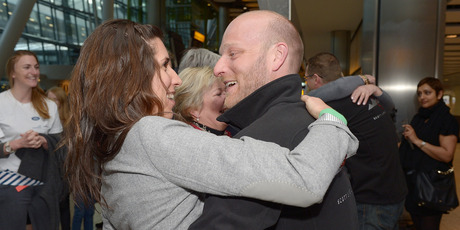
Ben Saunders and girlfriend Liz Dimmock embrace as Ben and
Tarka are reunited with friends and family at Heathrow airport. 
Much easier, then, to concentrate on the here and now, and the glow of the media's spotlight (it was Newsnight last night, Sky News tomorrow, me now). It helps keep alive an experience that's already being rapidly consigned to memory. The problem, he says, is that he no longer looks much like an explorer, not now that he has had a bath and a change of clothes. Unlike, say, Sir Ranulph Fiennes, who never looks anything less than fantastically ravaged, Saunders is still in possession of all his fingers, all his toes. The only lingering evidence of frostbite is a red mark on the bridge of his nose. He points it out, but it's infinitesimal, really. The man doesn't even look tired.
"I feel a bit of a fraud, to be honest. Did it all really happen? Hard to believe it was only a few weeks ago that I had hypothermia; I was hypoglycemic, starving, exhausted." He scratches at his chin. "Perhaps I should have kept the beard," he muses. "Never mind, next time."

LEOPARD ON THE LOOSE - TINEE WAS THERE

Leopard on loose in Indian city triggers panic

A leopard leaps across an under-construction structure near a furniture market in the Degumpur residential area as a bystander moves out of the way on Sunday in Meerut, India. A leopard sparked panic in a north Indian city when it strayed inside a hospital, a cinema and an apartment block before evading captors, an official said.
NEW DELHI — A leopard sparked panic in a north Indian city when it strayed inside a hospital, a cinema and an apartment block while evading captors, an official said Monday.
Authorities closed schools and colleges in Meerut, 60 kilometres (37 miles) northeast of theIndian capital, after the leopard was discovered prowling the city's streets on Sunday, a senior city official said.
"Despite our best efforts, we have been unable to track the leopard down. We have launched a massive hunt for the beast," said additional district magistrate S.K. Dubey.
The cat was found inside an empty ward of an army hospital on Sunday before wildlife officers were called and managed to fire a tranquiliser dart into it, Dubey told AFP.
"But despite that he managed to break (out through) the iron grilles and escaped. He then sneaked into the premises of a cinema hall before entering an apartment block. After that we lost track of the cat," he said.
Authorities have urged the closure of markets in the city of 3.5 million until the animal, which has left six people injured, was captured, according to the Press Trust of India (PTI) news agency.
Police, soldiers and wildlife officials were trying to hunt it down but their efforts were being hampered by large crowds keen to catch a glimpse of the cat, PTI said.
Photos showed the beast pushing its way through a lattice wall at the hospital as a policeman in riot helmet, stood ready to hit it with a baton.
The leopard was also pictured leaping off a building site as people scrambled out of the way.
Last week another leopard killed a five-year-old boy in the central state of Chhattisgarh, the latest in a string of incidents raising concerns about depleting habitats for big cats which is forcing them into populated areas.
Video footage from Mumbai last year showed a leopard creeping into an apartment block foyer and snatching a small dog.
A tiger on the prowl in the northern state of Uttar Pradesh since last December is believed to have killed some ten people, and wildlife officials are still trying to hunt it down.
Conservation group WWF called for better management of forests and other habitats forIndia's leopard population, which numbered 1,150 at a 2011 census.
"Leopards are large territorial mammals, they need space to move around. Some of their corridors are getting blocked so there is bound to be an interface," Deepankar Ghosh ofWWF-India told AFP.
"We can't put all the leopards into cages. We can't remove all the people living near forested areas. We have to manage the situation the best way we can."

Monday, February 24, 2014

TINEE WAS THERE - NOW YOU CAN PLAY THE GAME!!!

TINEE WAS THERE - NOW YOU CAN PLAY THE GAME!

PLAY THE "I AM TINEE" GAME

"TINEE WAS THERE" has become a huge success! Now you can play the OFFICIAL "TINEE WAS THERE" Jigsaw Puzzle Album. These are fun and easy (for now) puzzles, that you can assemble and try to find TINEE. The puzzles will become more difficult from time to time.

Good Luck!