
How two men succeeded where
Captain Scott failed
 |
| Polar explorer Ben Saunders and Tinee pictured in Antarctica. |
No one has ever completed Captain Scott’s ill-fated South Pole trek – until now. But, Ben Saunders tells The Independent, the biggest challenge was in convincing people how extraordinary the feat was.
As Ben Saunders sat in his tent updating his blog, the Antarctic wind in a foul mood outside, he could no longer feel his fingertips. Saunders and his co-explorer Tarka L'Herpiniere were 99 days into what would become a 105-day trek recreating - but, crucially, surpassing - Captain Scott's ill-fated 1912 expedition across the South Pole.
In one sense, they should have been in good spirits: Scott and his team had perished 11 miles short of their finish point, while Saunders and L'Herpiniere were alive. But they were cold, emaciated, weak and tired.
"We've had some wonderful, well-meaning messages imploring us to enjoy and treasure and cherish these last few days on the ice," Saunders, 36, wrote on 31 January, "but the truth is that the days are hellish now, and it's all we can do to keep moving, battling the ever stronger desire to stop and rest (or give in and quit entirely)."
The reader felt for him, of course, but not that much. No one had actually forced them out there, had they? Besides, we live in a world now where seemingly everyone - or at the very least actors, comedians, Typhoo Tea spokesmen, and the occasional fourth in line to the throne - is out there indulging in extreme adventurism while audibly complaining about how much it all hurts.
"We have extra food tomorrow, so things may improve," he continued, "but the enjoyment of these next few days will, I fear, only come in hindsight."
Whatever did they expect?
That was three weeks ago, and the journey was completed, successfully, six days later, after which he and L'Herpiniere repaired to Chile, to warm up, eat, and recover. Saunders is back in London now, sitting in front of me in his office space in Clapham, south-west London, and hindsight is very much in full effect. Though Clapham high street could be, for all sorts of reasons, far more dangerous than the Antarctic ever could be, he considers himself back on safe ground, familiar territory. He's just not sure he wants too much exposure to it; all those Sainsbury's, those great many Starbucks. "Being back here is very, very odd," he says, running a hand over his cropped hair. "I'm finding readjusting to real life quite difficult right now."
Looking at the man, you wouldn't think he'd just walked himself into the record books. All the weight he lost on the ice, 20kg, he's put back on, and beneath the white T-shirt that bears his name alongside those of his sponsors, Intel and Land Rover, is a lot of carefully cultivated muscle. He looks as if he spent the past three months in the gym rather than defying the bitter expanse at the bottom of the world.
Nevertheless, he and L'Herpiniere's achievements are mighty. The pair completed the longest man-haul polar journey in history, trekking 1,800 miles over pure white nothing while pulling supplies of up to 200kg for almost four months. "Or, to put it in another context, we completed 69 marathons back to back in the harshest place on earth - the coldest, the windiest, the driest, and the continent with the highest altitude. From a purely physical point of view," he says, "it really was a massive challenge."
One could argue that this doesn't need quite such strenuous underlining, but then again perhaps it does. If we really do live in a world where we're all wannabe Ben Fogles and Bear Gryllses, then it is increasingly easy to overlook what feels like just another polar expedition. "Yes, but no one has ever attempted what Scott did, not in 100 years. There is this misconception that everything in the world has been explored, but that's just not true."
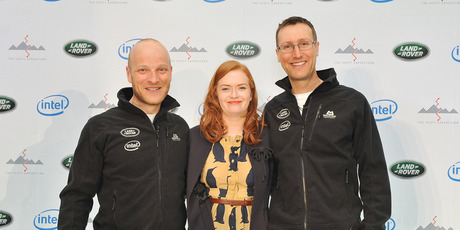 |
| From left, Ben Saunders, Lucy Scott, great granddaughter of Captain Scott, and Tarka L'Herpiniere. |
Consequently, one of the biggest challenges that the pair faced was convincing people of the enormity of their challenge. "Most contemporary expeditions are merely contrived publicity stunts. You know, the first left-handed Irishman on a stick, or the first person to ride there on a bike, or simply the latest Blue Peter presenter." But this, he insists, was different. "Our motivation was about exploring human limits: just how much are we capable of?"
Before he left, a friend told him that his grandmother was also headed to the Antarctic, on a cruise. "Do you think you might see her while you're down there?" he was asked. Saunders sighs. "I don't want to sit here and bad-mouth people, and say that, well, you know those wounded soldiers? They were only planning to do 200 miles..." Lest he give the impression of criticising the Walking With The Wounded charity, which last year trekked to his Pole of choice in the company of Prince Harry, he quickly adds that he knows a lot of them personally. "And I think what they achieved is incredible," he says. "I know how hard it is to do anything in those conditions as an able-bodied person, so I can't imagine what it must be like doing it while having to deal with a prosthetic limb."
"Being back here is very, very odd" Any Antarctic trek is an achievement, then. It's just that no one has ever walked that far, down there, in those conditions. They have now.
An affable man of genial disposition, Saunders likes to point out, a touch self-consciously perhaps, that he was not a born explorer; the tacit suggestion, presumably, is that some are. "It's not like I'm Sir Benjamin Saunders of so-and-so, and that I come from a long line of noted explorers. No, I'm entirely normal, ordinary. I went to state school, and didn't even make it as far as university." He nevertheless does sound rather well bred. "The posh accent?" he says, with a laugh. "I got that from my stepfather."
His real father was a bricklayer, his mother a secretary (his parents divorced when he was young), and he grew up in Devon and Cornwall. He didn't much like school, and liked it even less when a careers adviser told him that life as a tree surgeon might be a viable path. Instead, he grew up in thrall to adventurers. His hero was Chris Bonington, and he began researching how one goes about following in such footsteps. He learned that many explorers had graduated from the army, and so he enrolled at Sandhurst, managing 11 months before quitting: "I didn't respond well to being told what to do."
His first big expedition came in 2001, aged 23, when he attempted to reach the North Pole. He succeeded two years later, and then, in 2004, became only the third person, and also the youngest, to reach it alone on foot. That same year, he set his sights on its southern counterpart. "I knew it might take some arranging," he says. "I was thinking a year, maybe even two." Largely for logistical and bureaucratic reasons, it took 10. Cost was also a major factor. "It's not a cheap way to go camping, that's for sure."
Which is where Intel and Land Rover came in. I ask him how much it all cost, and he fidgets in his seat. "We've not really made that public." A ballpark number? "Into seven figures, I'll tell you that much."
It was thanks to the former sponsor's technology that he was able to blog from his laptop every day, his messages read around the world by fellow adventurers, schoolchildren and, he reveals, grinning, just the occasional troll. He and L'Herpiniere filmed much of their daily progress, and so a documentary is in the offing, and Saunders is working on a book of the trip. He clearly has a story, and it's his alone to tell. L'Herpiniere, who now lives in the shadow of the Alps and works as a computer programmer, has no interest in the spotlight. Saunders, on the other hand, does, and he is becoming increasingly in demand as a motivational speaker.
"Yes, but it makes my toes curl, that description: motivational speaker. Urgh." He grimaces. "Without trying to sound too new-age about it, or American, I do hope in some way I can inspire people to think about their potential. The one thing I have tested to the limit here, much more than any part of my body, is my self-belief. It has taken me a whole decade to make this happen, and it has been extraordinarily hard. It often felt as if everybody around me doubted whether it was even possible. So to set your mind to something, and to then achieve it, is gratifying."
But it's over now, and here he is, at home among the supermarkets and the coffee chains. A few years shy of his 40th birthday, he has achieved his life's ambition, and is already fretting over what's next. While in the Antarctic, he convinced himself that this was his last expedition. It was too hard, and he too old. But he is already pining to return. "I like extremes," he says, shrugging.
But what of real life? Does he have a girlfriend? I have to ask this twice because he avoids the question the first time, and his words come out in a mumble when he does answer. "I do, yes, but all this hasn't exactly been conducive to having a normal relationship."
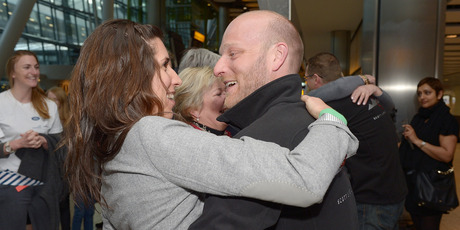 |
| Ben Saunders and girlfriend Liz Dimmock embrace as Ben and Tarka are reunited with friends and family at Heathrow airport. |
Much easier, then, to concentrate on the here and now, and the glow of the media's spotlight (it was Newsnight last night, Sky News tomorrow, me now). It helps keep alive an experience that's already being rapidly consigned to memory. The problem, he says, is that he no longer looks much like an explorer, not now that he has had a bath and a change of clothes. Unlike, say, Sir Ranulph Fiennes, who never looks anything less than fantastically ravaged, Saunders is still in possession of all his fingers, all his toes. The only lingering evidence of frostbite is a red mark on the bridge of his nose. He points it out, but it's infinitesimal, really. The man doesn't even look tired.
"I feel a bit of a fraud, to be honest. Did it all really happen? Hard to believe it was only a few weeks ago that I had hypothermia; I was hypoglycemic, starving, exhausted." He scratches at his chin. "Perhaps I should have kept the beard," he muses. "Never mind, next time."


