EXPLORE THE WORLD OF TINEE

Showing posts with label Learn. Show all posts

Tuesday, March 25, 2014

Egypt unveils two massive restored pharaoh statues

Egypt unveils two massive restored pharaoh statues


Archeologists in the historic city of Luxor, Egypt have unveiled two massive ancient statues of Pharaoh Amenhotep III to the public.

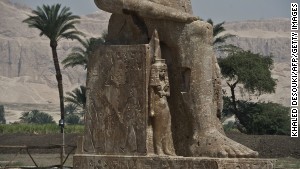
The newly restored quartzite statues, one of which is more than 11 meters high and weighs 250 tonnes, can be found at the funerary temple of Amenhotep III.

They join a pair of already famous giants at the temple known as the Colossi of Memnon -- two 16-meter-high images of King Amenhotep III
seated on his throne, also made of quartzite.

The unveiling was presided over by German archaeologist Hourig Sourouzian, who heads the temple of Amenhotep III conservation project.

The two new statues, discovered during excavations at the site, were originally in pieces before being restored and raised to their current standing position at the temple.

According to the World Monument Fund (WMF), the temple of Amenhotep III was erected between 1390 and 1353 B.C. for the pharaoh. It was 100 meters wide and 600 meters long, but only the lower sections of the structure remain.

Pharaoh Amenhotep III and his wife Tiye.

The Colossi of Memnon, which mark the entrance of the temple of Amenhotep III, are the most visible remains of what was once the most richly ornamented of all Thebanmonuments, says the WMF.

"The temple structure was originally destroyed by earthquakes, and, since it was never fully excavated, the site was overgrown with vegetation and threatened by seasonal floods and agricultural development," says the organization.

"These problems were compounded by an increase in surface salts from rising groundwater, a by-product of the construction of the Aswan High Dam in the 1960s."

Luxor, 635 kilometers from Cairo, is divided by the Nile into two areas commonly referred to as the East and West Bank -- the latter home to some of Egypt's most prized ancient temples and monuments.

The unveiling comes at a time when Egypt's tourism sector is fighting to pull itself out of a slump due to political instability that's lingered since the ousting of Hosni Mubarak in 2011.

According to the Daily News Egypt, Tourism Minister Hisham Zaazou said on Saturday that the tourism sector is completely collapsed, adding that great changes are needed to improve conditions.

TINEE discovers her own massive statue
Hawk Bridge Island


While traveling through Cloudstown one day, Tinee came across a floating island.


Tuesday, March 18, 2014

EASTER EGG ISLAND - "I AM TINEE"

I AM TINEE - By Swinda Reichelt

TINEE AND EASTER EGG ISLAND

One afternoon, Auntie Tantee was telling a story to Tinee about a special floating island far away from CloudsTown.
This fantastic place is where the Great Easter Bunny lives and prepares all of the beautifully decorated Easter Eggs. The Easter Bunny then hides these eggs all over the world early Easter morning. When the children wake up, they grab their Easter Baskets and try to collect as many as they can.
CLICK HERE TO PLAY THE TINEE'S EASTER ADVENTURE GAME!
While Tinee was listening to her Auntie's wonderful story, Tinee began to daydream about this amazing place. Suddenly her nose started to itchy twitchy, Tinee rubbed her nose and POOF!

The practice of decorating eggshell is ancient, pre-dating Christian traditions. Ostrich eggs with engraved decoration that are 60,000 years old have been found in Africa. Decorated ostrich eggs, and representations of ostrich eggs in gold and silver, were commonly placed in graves of the ancient Sumerians and Egyptians as early as 5,000 years ago.
The custom of the Easter egg, however, originated in the early Christians of Mesopotamia, who stained eggs red in memory of the blood of Christ, shed at his crucifixion. The Christian Church officially adopted the custom, regarding the eggs as a symbol of the resurrection.
Although the tradition is to use dyed or painted chicken eggs, a modern custom is to substitute chocolate eggs, or plastic eggs filled with confectionery such as jelly beans. These eggs can be hidden for children to find on Easter morning, which may be left by the Easter Bunny. They may also be put in a basket filled with real or artificial straw to resemble a bird's nest.


YOU CAN PLAY THE TINEE'S EASTER ADVENTURE HERE!

And be sure to look for more Exciting Stories from "I AM TINEE" by Swinda Reichelt. 

Saturday, March 8, 2014

DON'T FORGET DAYLIGHT SAVINGS TIME

TINEE SAYS - "DON'T FORGET DAYLIGHT SAVINGS TIME"

REMEMBER TO SPRING FORWARD!

WHY DO WE HAVE DAYLIGHT SAVINGS TIME?

Spring Forward to Daylight Saving Time and Longer Days

TINEE wants to Sleep-In!
Many will lose an hour of sleep on Sunday morning “no thanks” to Daylight Saving Time. As it gets warmer in many parts of the United States, as opposed to the long and cold nights people were forced to accept, they will now experience longer and warmer days. After Sunday, March 9 at 2 a.m. when Daylight Saving Time begins the sun will again brighten the morning before many have to be out for work and the children for school.
Daylight Saving Time (DST) is set to begin in just a few hours and as the clocks “spring forward” one hour we will lose an extra hour of sleep but will gain an extra hour of sun in the mornings.
Daylight Saving Time was initially introduced in 1895 by entomologist George Vernon Hudson. It began during World War II in an effort to save resources; the U.S. decided to make it mandatory for the entire country. Hudson thought it would be a means to extend daylight hours during the summer.
President Franklin D. Roosevelt actually adopted it as an energy-saving measure and called it “War Time.” It was not until 40 days after the bombing of Pearl Harbor that this new “law” was enforced. At that time it was recognized year round, now it has become optional for states. While most of the country hangs on to their observance of DST, Arizona and California are an exception to the rule.
The easiest way to remember which way the time adjusts between seasons is the simple mantra, fall back in the fall which usually occurs in October and sometimes November, and spring forward in spring or March. So, you’ll actually lose the hour of sleep you gained in November when the clocks fell back.
People who use personal computers, smart phones, tablets or other electronic devices won’t have to worry about adjusting the time. Many of today’s electronics should do it automatically. During this day that we live in it’s hard to imagine someone who does not have any of those electronic devices, but one can never be too sure. For those who do have items, especially alarm clocks, that need to be manually adjusted it would be wise to do so on Saturday night before turning in.
There are 25 long hours in the day when everyone “springs ahead.” Then in November when most of the country again “falls back” there will only be 23 short hours in the day.
As many say good-bye to Standard Time they will kiss an hour of sleep good-bye as well. The truth is many will never really feel it just as they did not feel the additional hour of sleep they gained at the end of DST. According to the experts one hour is never enough to help or hurt anyone because of their hectic lifestyle. It will take much more than an hour for any serious affect to one’s health and would need to occur on an ongoing basis.
The amount of sleep necessary for good health and optimum daytime performance varies according to an individual’s age. When the recommended sleep hours are not achieved the victim’s attentions levels and mood can be adversely affected. Ultimately the lack of sleep can turn into chronic sleep deprivation which can eventually result in potential health problems, decreased productivity and increased stress.
This Saturday night many within these United States and abroad will “spring forward” to longer days while losing an hour of sleep thanks to Daylight Saving Time. During the spring and summer months the sun will again brighten many people’s days before they have to be out for work and the children for school.

Thursday, March 6, 2014

NAME THE MOVIE - TINEE WANTS TO KNOW

CAN YOU NAME THE FILM?
JUST FROM A PICTURE?
TINEE WANTS TO KNOW?
1.

2.

3.

4.

5.

6.

7.

8.

9.

10.

11.

12.

13.

14.

15.


REPLY WITH COMMENTS:    TINEE'S NAME THE MOVIE

Monday, March 3, 2014

THEATER REVIEW - Broad Stage = MYTHICAL PLAYGROUND: BRAZIL - TINEE WAS THERE

MYTHICAL PLAYGROUND: BRAZIL
THE REVIEWS ARE IN!!!


Friday night around the dinner table, the girls (Esmé &Üla’ - 7 & 10 year old sisters ) shared what they witnessed and experienced at Mythical Playground: Brazil.
Esmé really liked the girl on the piano (Actress Julia Keefe), but she preferred (Actress Cassandra Nwokah) the house slave.
She was fixated on how Cassandra was bent and learned different ways to convey age and culture with clothes and accents.
Cassandra gave space around everything she said, to convey import.
Üla’s was most impressed with the student (Actor Colin Simon) of the Shaman (Actor Vikas Adam) (Esmé called the Shaman the Chief).  She acted out his bird imitation and the Shaman’s lines word for word.
Üla really liked when he (Colin) rolled out his long name and she (Julia) asked what it meant and he said, “boy.” She so got the joke.
Esmé jumped on the fact that the student’s (Colin) voice went up when he asked the girl (Julia) “can you play more for ME?”
They both loved the (Interaction & Sing-A-Long) call to response portions.  And it didn't seem like too much for them.  They absorbed it all.
They both alluded to the Termite joke in different ways this weekend.  Parodying it and when a comparison was made with a group of people on a show, Üla said, no mom, the termites are white those people aren't.  And we all loved the interaction on the fly when the kid in the audience said, “She doesn't look like a termite.” Colin's ad lib and said "No, she doesn't, she looks like a Princess."  So well played.

And I had fears that more and more children would rise from the audience and overwhelm the performers – but it was perfect. 

We enjoyed it and are still unraveling the complexity that Mythical Playground: Brazil gave a basis for.  Thank you

DOWSER FOR HIRE - WILL WORK FOR WATER - TINEE WAS THERE!

California farmers hire dowsers to find water


ST. HELENA, Calif. — With California in the grips of drought, farmers throughout the state are using a mysterious and some say foolhardy tool for locating underground water: dowsers, or water witches.
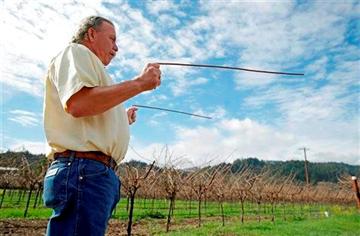
Practitioners of dowsing use rudimentary tools — usually copper sticks or wooden “divining rods” that resemble large wishbones — and what they describe as a natural energy to find water or minerals underground.
While both state and federal water scientists disapprove of dowsing, California “witchers” are busy as farmers seek to drill more groundwater wells because of the state’s record drought that persists despite recent rain.
The nation’s fourth-largest winemaker, Bronco Wine, says it uses dowsers on its 40,000 acres of California vineyards, and dozens of smaller farmers and homeowners looking for wells on their property also pay for dowsers. Nationwide, the American Society of Dowsers boasts dozens of local chapters, which meet annually at a conference.
“It’s kind of bizarre. Scientists don’t believe in it, but I do and most of the farmers in the valley do,” said Marc Mondavi, a vineyard owner whose family has been growing grapes and making wine since the mid-20th century in the Napa Valley.
Mondavi doesn’t just believe in dowsing, he practices it.
On a recent afternoon, standing in the Charles Krug vineyard holding two copper divining rods, Mondavi walked slowly forward through the dormant vines.
After about 40 feet, the rods quickly crossed and Mondavi — a popular dowser in the famous wine region — stopped. “This is the edge of our underground stream,” he said during the demonstration. Mondavi said he was introduced to “witching” by the father of a former girlfriend and realized he had a proclivity for the practice.
After the valley’s most popular dowser died in recent years, Mondavi has become the go-to water witch in Napa Valley. He charges about $500 per site visit, and more if a well he discovers ends up pumping more than 50 gallons per minute.
With more farmers relying on groundwater to irrigate crops, Mondavi’s phone has been ringing often as growers worry about extended years of dryness.
TINEE decided she wanted to try the Diving Rod herself...
TINEE at Fly Geyser, Black Rock, Nevada
And look what she found in the middle of the desert!


ANCIENT BEASTS ROAM SPAIN'S WILDERNESS - TINEE WAS THERE!

Ancient beasts roam Spain's wilderness

AFP 
Campanarios De Azaba (Spain) (AFP) - In an oak wood spanning the border of Spain and Portugal, an ancient sight unfolds: wild horses, not saddled or shoed, but roaming free as they did centuries ago.
Farming has declined in Spain, leaving the countryside deserted, conservationists say. Now the wild things are coming back: wolves, vultures and rare herbivores.
Dozens of Spanish "Retuerta" horses have been released over the past two years here into the 500-hectare (1,235-acre) Campanarios de Azaba Reserve.
"It's a wonderful horse that has been around since time immemorial," despite coming close to extinction, said Carlos Sanchez, director of the conservation group running the site.
"We are recovering the most primitive breeds to try to help manage an ecosystem which has been abandoned due to the disappearance of humans."
Nuzzling its mother's velvety brown hide, a foal suckles then disappears among the trees with the grazing herd.
"We released these animals to live by themselves, to take care of themselves in their environment," said conservationist Diego Benito, 35.
"We don't feed them. We just watch them and monitor how they are doing in their groups, which are the dominant horses and which of the mares are pregnant."
Overall in existence there are only about 150 Retuertas -- identified by genetic studies as one of the oldest horse breeds in Europe.
They were brought from the Donana National Park in southern Spain -- previously the only place where they existed -- to create a second breeding site in Campanarios, where they now number about 50.
Sharing the reserve with rare vultures and free-roaming cows, the Retuerta horses are among the animal pioneers of what conservationists call "rewilding".
The Campanarios reserve is part-funded by Rewilding Europe, an initiative for development through "wild nature" in various countries.
"For the first time in history, Europe is facing a situation where there is no grazing anymore," said Frans Schepers, managing director of the Netherlands-based organisation.
"There has been a lot of land abandonment in Spain over the past few decades," he said.
- Wildlife comeback -
Therefore, in recent years "Spain has shown a very interesting wildlife comeback," with wolves, vultures and even the endangered Iberian lynx recovering in numbers, he added.
Rewilding aims to turn this into an economic opportunity, to draw visitors and revive abandoned rural areas in the long-term.
The Campanarios reserve, currently inhabited just by the animals and a handful of staff, aims to draw groups of wildlife spotters and boost the local economy.
Jon Teixeira, 27, works in the reserve planting trees, releasing rabbits and leaving dead chickens for vultures to feed on.
"I am glad there is a reserve here -- that way we'll have jobs in the area, where there's a lot of unemployment," he said.
"And it's a good job there's a place where you can't hunt, otherwise all the animals would be wiped out."
Elsewhere, conservationists this month released a herd of wild oxen to graze in a reserve near the northern Spanish city of Burgos.
- Stone age safari -
In the coming months they plan to add endangered European bison and other breeds of wild horse to the reserve.
The oxen were set free near the Atapuerca prehistoric site, where archeologists have dug up human remains more than a million years old.
Conservationists want to take people visiting the dig on a stone age safari to see the living descendants of the beasts that roamed the area aeons ago.
"In the archaeological site lie the bones of the ancestors of todays' species. These are their evolutionary descendants," said Fernando Moran, a bison specialist at the park.
The Atapuerca site is not part of the Rewilding Europe initiative, but it shares the aim of drawing money and jobs to the abandoned rural areas while also preserving endangered species.
"It is about nature conservation, but also tourism, development and land management," Moran added.
"Spain is in general a fair bit more wild than the rest of Europe. Lots of hectares are being left empty, which for wild animals are obviously perfect."

Sunday, March 2, 2014

RED CARPET HISTORY - TINEE WAS THERE!

TINEE checking out RIVER OSCAR

Last night, Academy Award Officials were showing signs concern as to whether "WEATHER" or not the rain would be kind to the BIG event tomorrow. 

Red Carpet Luxury Kayak Rentals were being considered.

O'NEIL Wet Tux's were also ready and standing by.


1922 Robin Hood Premiere

For decades, stars great, small and dubious have swanned down the Oscars’ regal rug. Turns out the backstory is as rich and multifarious as a David O. Selznick epic.

1922
Hollywood’s first red carpet event usually is ascribed to the opening of Sid Grauman’s Egyptian Theatre and the premiere of Robin Hood, starring Douglas Fairbanks. The irrepressible Grauman, a founding Academy of Motion Picture Arts and Sciences member, later would take credit for the red carpet becoming a staple at Hollywood events.
1961
The first Oscars red carpet is rolled out at the 33rd Academy Awards on April 17, 1961, at the Santa Monica Civic Auditorium.
1966
The Oscars are broadcast in color for the first time, giving millions of viewers a glimpse of the red carpet in living color on fruitwood-trimmed console Zeniths.
1992
The American Turf and Carpet company takes over making the Oscars’ red carpet. The continuous filament nylon creation is manufactured and dyed in Dalton, Ga., and replaced every two years. The carpet is not wholly red. It’s dyed with a proprietary blend of colors used exclusively for the carpet to make it read red on television (“Nancy Reagan Red,” Rivers has called it) and sealed to prevent the color from degrading under assault from innumerable ManoloBlahniks.
2001
The Oscars move to the Kodak (now Dolby) Theatre. The red carpet follows.
2003
U.S. forces invade Iraq three days before the Oscars. In deference, the preshow hoopla is scaled back dramatically, including the red carpet itself, which shrinks to a vestigial doormat in front of the theater entrance.
2013
A metastasizing number of awards events and premieres inspires organizers to roll out carpets in yellow (like at 2013’s Nickelodeon Kids’ Choice Awards), blue, pink and even white. The Grammys, Emmys and Oscars remain steadfastly red.
2014
Today’s Oscar red carpet has grown to 16,500 square feet and takes two days to install. Scraps are jealously guarded to keep them out of the mitts of eBay trolls.


MYTHICAL PLAYGROUND: BRAZIL - TINEE WAS THERE!!


MYTHICAL PLAYGROUND - BRAZIL
LIVE AT THE BROAD STAGE
TINEE WAS THERE!
Santa Monica, CA - The BROAD STAGE in Santa Monica and the IPANEMA THEATER TROUPE with Brazilian director Gulu Monteiro and Costume Designer Swinda Reichelt, this newest theatrical creation guides us through the dynamic music, heritage and culture of Brazil. Mingling modern traditions with the folklore of old, Monteiro weaves a new classic tale for children and the young at heart.  
Ipanema Theater Troupe
The unique spirit of 18th century Brazil as we explore their heritage through music and culture and follow the story of a Native boy who falls in love with a European girl who encounters the wisdom of the girl’s African caretaker.

Starring:  
VIKAS ADAMCLARA BELLAR
STEVEN HOUSKA
JULIA KEEFE
CASSANDRA NWOKAH
COLIN SIMON
GULU MONTEIRO
DREW LOVE
ANAS SAHIBI
EROCK M dos SANTOS
AMEN SANTO


The 86th Academy Awards Official TINEE OSCAR BALLOT

The 86th Academy Awards
Official TINEE OSCAR BALLOT

Tuesday, February 25, 2014

LEOPARD ON THE LOOSE - TINEE WAS THERE

Leopard on loose in Indian city triggers panic

A leopard leaps across an under-construction structure near a furniture market in the Degumpur residential area as a bystander moves out of the way on Sunday in Meerut, India. A leopard sparked panic in a north Indian city when it strayed inside a hospital, a cinema and an apartment block before evading captors, an official said.
NEW DELHI — A leopard sparked panic in a north Indian city when it strayed inside a hospital, a cinema and an apartment block while evading captors, an official said Monday.
Authorities closed schools and colleges in Meerut, 60 kilometres (37 miles) northeast of theIndian capital, after the leopard was discovered prowling the city's streets on Sunday, a senior city official said.
"Despite our best efforts, we have been unable to track the leopard down. We have launched a massive hunt for the beast," said additional district magistrate S.K. Dubey.
The cat was found inside an empty ward of an army hospital on Sunday before wildlife officers were called and managed to fire a tranquiliser dart into it, Dubey told AFP.
"But despite that he managed to break (out through) the iron grilles and escaped. He then sneaked into the premises of a cinema hall before entering an apartment block. After that we lost track of the cat," he said.
Authorities have urged the closure of markets in the city of 3.5 million until the animal, which has left six people injured, was captured, according to the Press Trust of India (PTI) news agency.
Police, soldiers and wildlife officials were trying to hunt it down but their efforts were being hampered by large crowds keen to catch a glimpse of the cat, PTI said.
Photos showed the beast pushing its way through a lattice wall at the hospital as a policeman in riot helmet, stood ready to hit it with a baton.
The leopard was also pictured leaping off a building site as people scrambled out of the way.
Last week another leopard killed a five-year-old boy in the central state of Chhattisgarh, the latest in a string of incidents raising concerns about depleting habitats for big cats which is forcing them into populated areas.
Video footage from Mumbai last year showed a leopard creeping into an apartment block foyer and snatching a small dog.
A tiger on the prowl in the northern state of Uttar Pradesh since last December is believed to have killed some ten people, and wildlife officials are still trying to hunt it down.
Conservation group WWF called for better management of forests and other habitats forIndia's leopard population, which numbered 1,150 at a 2011 census.
"Leopards are large territorial mammals, they need space to move around. Some of their corridors are getting blocked so there is bound to be an interface," Deepankar Ghosh ofWWF-India told AFP.
"We can't put all the leopards into cages. We can't remove all the people living near forested areas. We have to manage the situation the best way we can."